John Dewey (1859-1952)
A philosopher of democracy

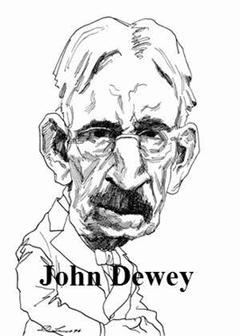
John Dewey was born in Burlington, Vermont to a family of modest means. He received his Ph.D. at Johns Hopkins University in 1884. Today, he is considered as one of the more influential philosophers of 20th century, a pioneer of pragmatist school of philosophy, and a leader of the progressive movement in education in the US. Dewey spent the majority of his career at Columbia University in New York City where he wrote his most famous philosophical works.
If you want to support this work with employee ownership
and workplace democracy, then please click on the link below to contribute to the:
Institute for Economic Democracy.
The common theme underlying Dewey’s philosophical and political work was his strong belief that democratic society of informed and engaged inquirers was the best arrangement of promoting human well-being. Dewey saw democracy as an active process of social planning, a collective action in different spheres of social life, but also as a source of morality, values, and beliefs that provide guidance for the evolution of social institutions. Dewey himself stated in 1888, while still at the University of Michigan, “Democracy and the one, ultimate, ethical ideal of humanity are to my mind synonymous.” In a democratic end state, people would treat each other with respect and there would be high levels of cooperation. One of the modern institutions that democracy did not yet manage to penetrate is an economic enterprise, Dewey claimed. There are many quotes from Dewey’s works about industrial democracy and cooperative production. Here are a few.
It is the work of sociologists, psychologists, novelists, dramatists and poets to exhibit the consequences of our present economic regime upon taste, desire, satisfaction and standards of value. An article like this cannot do a work which requires many volumes. But a paragraph suffices to call attention to one central fact. Most of those who are engaged in the outward work of production and distribution of economic commodities have no share-- imaginative, intellectual, emotional--in directing the activities in which they physically participate.
It was remarked in an earlier chapter that there is definite restriction placed upon existing corporateness. It is found in the fact that economic associations are fixed in ways which exclude most of the workers in them from taking part in their management. The subordination of the enterprises to pecuniary profit reacts to make the workers ‘hands’ only. Their hearts and brains are not engaged. They execute plans which they do not form, and of whose meaning and intent they are ignorant-beyond the fact that these plans make a profit for others and secure a wage for themselves. To set forth the consequences of this fact upon the experience and the minds of uncounted multitudes would again require volumes. But there is an undeniable limitation of opportunities, and minds are warped, frustrated, unnourished by their activities--the ultimate source of all constant nurture of the spirit. The philosopher’s idea of a complete separation of mind and body is realized in thousands of industrial workers, and the result is a depressed body and an empty and distorted mind.
There are instances, here and there, of the intellectual and moral effects which accrue when workers can employ their feelings and imaginations as well as their muscles in what they do. But it is still impossible to foresee in detail what would happen if a system of cooperative control of industry were generally substituted for the present system of exclusion. There would be an enormous liberation of mind, and the mind thus set free would have constant direction and nourishment. Desire for related knowledge, physical and social, would be created and rewarded; initiative and responsibility would be demanded and achieved. One may not, perhaps, be entitled to predict that an efflorescence of a distinctive social culture would immediately result. But one can say without hesitation that we shall attain only the personal cultivation of a class, and not a characteristic American culture, unless this condition is fulfilled. It is impossible for a highly industrialized society to attain a widespread high excellence of mind when multitudes are excluded from occasion for the use of thought and emotion in their daily occupations. The contradiction is so great and so pervasive that a favorable issue is hopeless. We must wrest our general culture from an industrialized civilization; and this fact signifies that industry must itself become a primary educative and cultural force for those engaged in it.” [Dewey, John. 1962 (1930). Individualism Old and New. Capricorn Books, pp. 131-33]
This passage should be compared to passage from John Stuart Mill about the effects that workplace democracy could have on people.
In Reconstruction in Philosophy, Dewey argued that democracy
is but a name for the fact that human nature is developed only when its elements take part in directing things which are common, things for the sake of which man and women form groups-families, industrial companies, governments, churches, scientific associations and so on. The principle holds as much of one form of association, say in industry and commerce, as it does in government [Dewey, John. 1948. Reconstruction in Philosophy (Enlarged Edition). Beacon Press, 209].
After World War II, Dewey repeated what he said about social reorganization after World War I:
It is so common to point out the absurdity of conducting a war for political democracy which leaves industrial and economic autocracy practically untouched, that I think we are absolutely bound to see, after the war, either a period of very great unrest, . . . or a movement to install the principle of self-government within industries [Dewey in: Ratner, Joseph. 1939. Intelligence in the Modern World: John Dewey’s Philosophy. Modern Library, 422].
For illustration, I do not need to do more than point to the moral, emotional and intellectual effect upon both employers and laborers of the existing industrial system. . . . I suppose that every one who reflects upon the subject admits that it is impossible that the ways in which activities are carried on for the greater part of the 16 waking hours of the day, and the way in which the share of individuals are involved in the management of affairs in such a matter as gaining a livelihood and attaining material and social security, can not but be a highly important factor in shaping personal dispositions; in short, forming character and intelligence. [Dewey in: Ratner, Joseph. 1939. Intelligence in the Modern World: John Dewey’s Philosophy. Modern Library, 716-17]
While “democratic social organization make[s] provision for this direct participation in control: in the economic region, control remains external and autocratic” [Dewey, John. 1916. Democracy and Education. Free Press, 260]
Control of industry is from the top downwards, not from the bottom upwards. The greater number of persons engaged in shops and factories are ‘subordinates.’ They are used to receiving orders from their superiors and acting as passive organs of transmission and execution. They have no active part in making plans or forming policies-the function comparable to the legislative in government-nor in adjudicating disputes which arise. In short their mental habits are unfit for accepting the intellectual responsibilities involved in political self-government. [Dewey, John, and James Tufts. 1932. Ethics. Henry Holt, 393-92]
Great quotes as usual David, thank you