John Stuart Mill (1806-1873)
Part of our weekly series of people less-known as supporters of workplace democracy

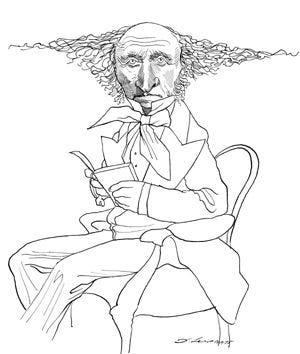
Mill was a British political economist, political philosopher, and a prolific classical liberal who surely stands among the most read and influential thinkers in the history of liberalism. J. S. Mill was, since he was a very young, educated into what his father hoped to be the leading intellectual of the time who would continue to promote the utilitarian principles of Jeremy Bentham and his father, James Mill. As a moral philosopher, J. S. Mill continued this tradition. As a political economist, Mill continued the liberal maxims of individual freedom, freedom to trade and barter. He was one of the first feminist thinkers, and as a politician, he was a very early proponent of women’s right to vote. He also advocated for unions and co-operative economic organization. It is a less known fact that Mill was a strong proponent of the democratization of industry; he believed that “eventually”, the economy will be organized wholly on co-operative principles. Probably Mill’s most famous passages about worker ownership are from his Principles of Political Economy in the Chapter entitled “On the Probable Futurity of the Labouring Classes.”
But if public spirit, generous sentiments, or true justice and equality are desired, association, not isolation, of interests, is the school in which these excellences are nurtured. The aim of improvement should be not solely to 3 place human beings in a condition in which they will be able to do without one another, but to enable them to work with or for one another in relations not involving dependence. ... But the civilizing and improving influences of association, ..., may be obtained without dividing the producers into two parties with hostile interests and feelings, the many who do the work being mere servants under the command of the one who supplies the funds, and having no interest of their own in the enterprise except to earn their wages with as little labor as possible. ... The form of association, however, which if mankind continue to improve, must be expected in the end to predominate, is not that which can exist between a capitalist as chief, and workpeople without a voice in the management, but the association of the labourers themselves on terms of equality, collectively owning the capital with which they carry on their operations, and working under managers elected and removable by themselves. ... It is scarcely possible to rate too highly this material benefit, which yet is as nothing compared with the moral revolution in society that would accompany it: the healing of the standing feud between capital and labour; the transformation of human life, from a conflict of classes struggling for opposite interests, to a friendly rivalry in the pursuit of a good common to all; the elevation of the dignity of labour; a new sense of security and independence in the labouring class; and the conversion of each human being’s daily occupation into a school of the social sympathies and the practical intelligence. [Mill, John Stuart. 1848. Principles of Political Economy, Book IV, Chapter VII]
Eventually, and in perhaps a less remote future than may be supposed, we may, through the co-operative principle, see our way to a change in society, which would combine the freedom and independence of the individual, with the moral, intellectual, and economical advantages of aggregate production; and which, without violence or spoliation, or even any sudden disturbance of existing habits and expectations, would realize, at least in the industrial department, the best aspirations of the democratic spirit, by putting an end to the division of society into the industrious and the idle, and effacing all social distinctions but those fairly earned by personal services and exertions. Associations like those which we have described, by the very process of their success, are a course of education in those moral and active qualities by which alone success can be either deserved or attained. As associations multiplied, they would tend more and more to absorb all work-people, except those who have too little understanding, or too little virtue, to be capable of learning to act on any other system than that of narrow selfishness. As this change proceeded, owners of capital would gradually find it to their advantage, instead of maintaining the struggle of the old system with work-people of only the worst description, to lend their capital to the associations; to do this at a diminishing rate of interest, and at last, perhaps, even to exchange their capital for terminable annuities. In this or some such mode, the existing accumulations of capital might honestly, and by a kind of spontaneous process, become in the end the joint property of all who participate in their productive employment: a transformation which, thus effected, (and assuming of course that both sexes participate equally in the rights and in the government of the association)* would be the nearest approach to social justice, and the most beneficial ordering of industrial affairs for the universal good, which it is possible at present to foresee. [Ibid. pp. 793-4]
Many have tried to downplay Mill’s views here by claiming that he was only accommodating the views of Harriett Taylor (his future wife). But Mill expressed similar views (somewhat less expansively) in his chapter on partnership and in an earlier 1845 essay “The Claims of Labour” (neither of which showed any influence from Taylor).
Finally, I must repeat my conviction, that the industrial economy which divides society absolutely into two portions, the payers of wages and the receivers of them, the first counted by thousands and the last by millions, in neither fit for, nor capable of, indefinite duration: and the possibility of changing this system from one of combination without dependence, and unity of interest instead of organized hostility, depends altogether upon the future developments of the Partnership principle. [Mill, John Stuart. 1848. Principles of Political Economy, 4 Book V, Chapter IX, sec. 5]
If, on a subject on which almost every thinker has his Utopia, we might be permitted to have ours; if we might point to the principle on which, at some distant date, we place our chief hope for healing the widening breach between those who toil and those who live on the produce of former toil; it would be that of raising the labourer from a receiver of hire--a mere bought instrument in the work of production, having no residuary interest in the work itself--to the position of being, in some sort, a partner in it. [Mill, John Stuart. 1967. “The Claims of Labour.” In Essays on Economics and Society; Collected Works Vol. IV, 363–89. University of Toronto Press]
Really great dive into Mill's cooperative vision. What stands out is how Mill saw worker ownership not just as an economic reform but as moral transformation that could end the class struggle between capital and labor. His idea that existing capital could "spontaneously" transition to joint property through diminising interest rates seems almost naive now, but back then cooperatives were genuinely spreading.